PDF
This Issue...

THE
CHRISTIAN’S RESPONSE TO THE
RISE OF THE RELIGION OF ISLAM IN AMERICA
Gary McDade
The presence of Muslims in the Congress of the Unites States of America
is an indication of “the rise of the religion of Islam in
America.” These Muslims are: André Carson (D-IN),
Ilhan
Omar (D-MN), Lateefah Simon (D-CA), and Rashida Tlaib (D-MI). Professor
Victor Davis Hanson recently observed America is becoming an Islamic
Socialist Republic. A case in point is the new mayor of New York City,
Zohran Mamdani who has declared himself to be an Islamic socialist. The
political views of all these people aside, the purpose of mentioning
them is to establish the reality of the “rise of the religion
of
Islam in America.” Also, the increase of the number of
mosques in
the USA from 1,209 in 2000 to 3,150 in 2026, more than double,
quantifies numerically the “rise of the religion of Islam in
America.”
Outside of the political
arena, what is the
Christian’s response? In America, the First Amendment of the
Constitution assures freedom of speech, but in some other countries the
Christian’s response offered here could bring a death
sentence. A
threefold response follows.
One, point out the god of
the Quran,
although referred to as Allah (meaning god) and is referred to in the
Quran as the Beneficent, is not the God of the Bible. Proof comes from
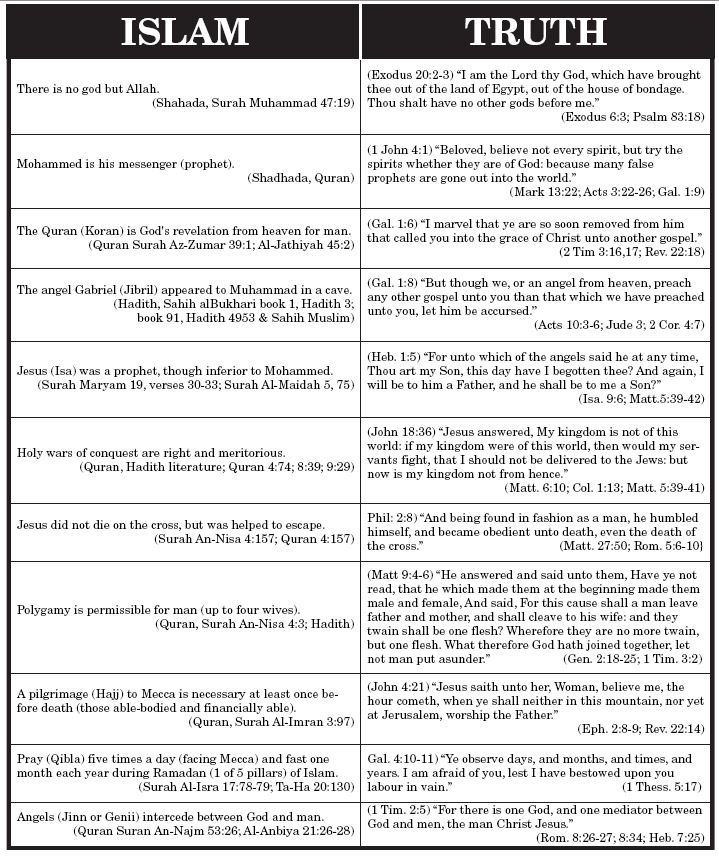
the Quran and the Bible. The Quran says god has no son; the Bible says
God has a Son.
The Quran:
“And they say: The
Beneficent has taken to Himself a son. Certainly you make an abominable
assertion! The heavens may almost be rent thereat, and the earth cleave
asunder, and the mountains fall down in pieces, That they ascribe a son
to the Beneficent! And it is not worthy of the Beneficent that He
should take to Himself a son” (Surah Mary a.k.a. chapter
19:88-92).
The Bible:
“While he yet
spake, behold, a bright cloud overshadowed them: and behold a voice out
of the cloud, which said, This is My beloved Son, in whom I am well
pleased; hear ye Him” (Matt. 17:5). Also, “And
Jesus
answered them, saying, The hour is come, that the Son of man should be
glorified.... Father, glorify Thy name. Then came there a voice from
heaven, saying, I have both glorified it, and will glorify it
again” (John 12:23,28). And, the memorable John
3:16, “For
God so loved the world, that He gave His only begotten Son, that
whosoever believeth in Him should not perish, but have everlasting
life.”
These contrasts from the
Quran and the Bible prove the religion of Islam to be a false religion.
Two, point out the Muslims
are
monotheistic, that is, the Quran affirms only one single person is
their god. The Bible speaks of the Godhead, that is, the Father, the
Son, and the Holy Spirit. Therefore, the god of the Quran is not the
God of the Bible.
The Quran: “That
is Allah,
your Lord. There is no god but He; the Creator of all things; therefore
serve Him, and He has charge of all things” (Surah The Cattle
a.k.a chapter 6:103). “Say: He, Allah, is One. Allah is He on
Whom all depend. He begets not, nor is He begotten: And none is like
Him” (Surah The Unity a.k.a. chapter 112:1-4).
The Bible:
“Go ye
therefore, and teach all nations, baptizing them in the name of the
Father, and of the Son, and of the Holy Ghost”
(Matt. 28:19). “The
grace of the Lord Jesus Christ, and the love of God, and the communion
of the Holy Ghost, be with you all. Amen” (2 Cor.
13:14). “Forasmuch
then as we are the offspring of God, we ought not to think that the
Godhead is like unto gold, or silver, or stone, graven by art and
man’s device” (Acts 17:29). “For
the invisible
things of Him from the creation of the world are clearly seen, being
understood by the things that are made, even His eternal power and
Godhead; so that they are without excuse” (Rom.
1:20). “For in Him [Jesus Christ] dwelleth
all the fulness of the Godhead bodily” (Col. 2:9).
These contrasts from the
Quran and the Bible prove the religion of Islam to be a false religion.
Three, point out the Quran
itself calls for
the death of non-believers and for those who do not believe in their
monotheism. The Bible commands “love thy enemies”
(Matt.
5:44) and “turn the other cheek” (Luke 6:29).
The Quran: “And
kill them
wherever you find them, and drive them out from where they drove you
out, and persecution is worse than slaughter. And fight not with them
at the Sacred Mosque until they fight with you in it; so if they fight
you (in it) slay them. Such is the recompense of the
disbelievers” (Surah The Cow a.k.a. chapter 2:191). And,
“So when the sacred months have passed, slay the idolaters
[polytheists], wherever you find them, and take them captive and
besiege them and lie in wait for them in every ambush. But if they
repent and keep up prayer and pay the poor-rate, leave their way free.
Surely Allah is Forgiving, Merciful” (Surah The Immunity
a.k.a.
chapter 9:5).
The Bible: “Ye
have heard
that it hath been said, Thou shalt love thy neighbor, and hate thine
enemy. But I say unto you, Love your enemies, bless them that curse
you, do good to them that hate you, and pray for them which
despitefully use you, and persecute you” (Matt.
5:43-44). And, “But
I say unto you, That ye resist not evil: but whosoever shall smite thee
on thy right cheek, turn to him the other also”
(Matt. 5:39).
These contrasts from the
Quran and the Bible prove the religion of Islam to be a false religion.
False religions in America
have twisted the
Scriptures not only to their own destruction but also to the ruination
of the nation (2 Peter 3:16). How sad that America seems never to have
learned the lesson Jesus taught when He said, “And
if a kingdom be divided against itself, that kingdom cannot
stand” (Mark 3:24).
Perhaps by looking for ways
to apply this
“Christian response to the rise of the religion of Islam in
America” the church will be empowered to take the proper
stand
against this evil. Wisdom shows that “Righteousness
exalteth a nation: but sin is a reproach to any people”
(Prov. 14:34). Before listing the Christian’s spiritual
armor, the apostle to the gentiles said, “Wherefore
take unto you the whole armor of God, that ye may be able to withstand
in the evil day, and having done all to stand. Stand
therefore...” (Eph. 3:10).
B36016@aol.com
Table of Contents

ISLAM’S
IDENTIFYING MARKS
Garland M. Robinson
When examining anything, it is essential that we observe its
“marks of identity.” For example: if your car is
stolen you
would give police its characteristic marks. You would give them the
make, model and year, its color and any dents, blemishes or other
identifying marks. If it’s a car, that automatically
eliminates
trucks. If it is white, that automatically eliminates cars that are
red, gray, blue, silver, etc. If it had a scratch or dent, that would
eliminate cars without scratches or dents.
When someone is missing,
the family gives
the identifying marks of that person. It may be a 25 year old woman
with dark shoulder length hair. She is 5 feet 6 inches tall and weighs
140 pounds. That information excludes men. Women 5 feet tall or 6 feet
tall are eliminated. Women with red or light colored hair are
eliminated.
This principle is true
regarding religions
of the world. When we read of the church in the New Testament we
recognize its characteristics. We examine religions in the world to see
if they match what we read about in the New Testament.
Let’s put the
characteristics of
Islam to the test regarding the church we read about in the New
Testament. It fails in every point.
Islam has the wrong FOUNDER: Mohammed
God told Abraham: “in
thy seed shall all the nations of the earth be
blessed” (Gen. 22:18). This promise would be
fulfilled through his wife Sarah not Hagar.
“Abraham said unto God, O that Ishmael
might live before thee! And God said, Sarah thy
wife shall bear thee a son indeed; and thou shalt call his name Isaac:
and I will establish my covenant with him for an
everlasting covenant, and with his seed
after him. And as for Ishmael, I have heard thee: Behold, I have
blessed him, and will make him fruitful, and will multiply him
exceedingly; twelve princes shall he beget, and I will make him a great
nation. But my covenant will I establish with Isaac, which
Sarah shall bear unto thee” (Gen.
17:19-21).
Jesus is the Christ, the
redeemer, the
messiah, the fulfillment of the “seed” promise. By
the
inspiration of the true and living God, Paul reveals the identity of
the “seed” of God’s promise. “Now
to Abraham and his seed [singular] were
the promises made. He saith not, And to seeds, as of many;
but as of one, And to thy seed, which is CHRIST”
(Gal. 3:16). Jesus is the savior that was promised — the only
begotten Son of God (John 3:16).
The apostle John wrote
these words: “In
the beginning was the Word, and the Word was with God, and the Word was
God. The same was in the beginning with God. All things were made by
him; and without him was not any thing made that was made”
(John 1:1-3). In verse 14 we read: “And
the Word was made flesh, and dwelt among us, (and we beheld his glory,
the glory as of the only begotten of the Father,) full of grace and
truth.”
Ephesians 2:13-21: “But
now in Christ Jesus ye who sometimes were far off
are made nigh by the blood of Christ. For he is our peace, who hath
made both one [Jew & Gentile], and
hath broken down the middle wall of partition between us; Having
abolished in his flesh the enmity, even the law of commandments
contained in ordinances; for to make in himself of twain one new man,
so making peace; And that he might reconcile both unto God in one body
by the cross, having slain the enmity thereby: And came and preached
peace to you which were afar off, and to them that were nigh. For through
him
we both have access by one Spirit unto the Father. Now therefore ye are
no more strangers and foreigners, but fellowcitizens with the saints,
and of the household of God; And are built upon the
foundation of the apostles and prophets, Jesus Christ himself being the
chief corner [stone]; In whom all the building fitly framed
together groweth unto an holy temple in the Lord”
(Eph. 2:13-21).
Islam has the wrong HEAD: Mohammed.
Jesus the Christ is the
head of the church, the eternal kingdom of God — not
Mohammed. “And hath put all things under his feet
[Jesus the Christ], and gave him to be the head
over all things to the church, Which is his body, the fulness of him
that filleth all in all” (Eph. 1:22-23). But
speaking the truth in love, may grow up into him in all things, which
is the head, even Christ” (Eph. 4:15). “And
he [Jesus the Christ] is
the head of the body, the church: who is the beginning, the firstborn
from the dead; that in all things he might have the
preeminence” (Col. 1:18). “Unto
you therefore which believe he is precious: but unto them which be
disobedient, the stone which the builders disallowed, the same is made
the head of the corner, And a stone of stumbling, and a rock of
offence, even to them which stumble at the word, being disobedient:
whereunto also they were appointed” (1 Peter
2:7-8).
Jesus is the savior of the
world. “For unto you is born this day in the city
of David a Saviour, which is Christ the Lord” (Luke
2:11). “...This is indeed the Christ, the Saviour
of the world” (John 4:42). “...The
Saviour, the Lord Jesus Christ” (Phil. 3:20). “...Our
Saviour Jesus Christ, who hath abolished death, and hath brought life
and immortality to light through the gospel” (2
Tim. 1:10; Acts 13:23, Eph. 5:23).
Islam began at the WRONG PLACE: Mecca
The promised messiah, Jesus
the Christ, would establish his kingdom in Jerusalem. “And
it shall come to pass in the last days, that the mountain of the
LORD’S house shall be established in the top of the
mountains,
and shall be exalted above the hills; and all nations shall flow unto
it. And many people shall go and say, Come ye, and let us go up to the
mountain of the LORD, to the house of the God of Jacob; and he will
teach us of his ways, and we will walk in his paths: for out of Zion
shall go forth the law, and the word of the LORD from Jerusalem”
(Isa. 2:2-3; Micah 4:1-3).
The church of Christ began
in Jerusalem. “From that time forth began Jesus to
shew unto his disciples, how that he must go unto Jerusalem,
and suffer many things of the elders and chief priests and scribes, and
be killed, and be raised again the third day. And, behold, I send the
promise of my Father upon you: but tarry ye in the city of
Jerusalem, until ye be endued with power from on
high” (Luke 24:49-53). “And,
being assembled together with them, commanded them that they should not
depart from Jerusalem,
but wait for the promise of the Father, which, saith he, ye have heard
of me. ... But ye shall receive power, after that the Holy Ghost is
come upon you: and ye shall be witnesses unto me both in Jerusalem,
and in all Judaea, and in Samaria, and unto the uttermost part of the
earth. ... Then returned they unto Jerusalem...”
(Acts 1:4,8,12). “And
when the day of Pentecost was fully come, they were all with one accord
in one place. And suddenly there came a sound from heaven as of a
rushing mighty wind, and it filled all the house where they were
sitting. And there appeared unto them cloven tongues like as of fire,
and it sat upon each of them. And they were all filled with the Holy
Ghost, and began to speak with other tongues, as the Spirit gave them
utterance” (Acts 2:1-4).
Islam began at the WRONG TIME: 622 A.D.
The eternal kingdom (the
church of Christ)
was prophesied to began during the days of the Roman Empire (circa 146
BC — 476 AD). “And in the days of these
kings shall the
God of heaven set up a kingdom, which shall never be destroyed: and the
kingdom shall not be left to other people, but it shall break in pieces
and consume all these kingdoms, and it shall stand for ever”
(Daniel 2:44).
The church of Christ, the
promised kingdom,
was established in 33 AD during the days of the Roman kingdom
—
600 years earlier than Islam. The Roman Empire ended 150 years before
Islam.
Jesus said: “There
be some of
them that stand here, which shall not taste of death, till they have
seen the kingdom of God come with power” (Mark
9:1). “Who hath delivered us from the power of
darkness, and hath translated us into the kingdom of his dear
Son” (Col. 1:13).
Islam has the wrong LAW: Qur’an
(Al-Qur’an)
The word of the Lord, the
Bible, the New Testament, governs all mankind. Jesus said: “He
that rejecteth me, and receiveth not my words, hath
one that judgeth him: the word that I have spoken, the same
shall judge him in the last day” (John
12:48). “The Father judgeth no man, but hath
committed all judgment unto the Son” (John 5:22). “All
scripture is given by inspiration of God, and is profitable for
doctrine, for reproof, for correction, for instruction in
righteousness: That the man of God may be perfect,
throughly furnished unto all good works” (2 Tim.
3:16-17). “Because he [God] hath
appointed a day, in the which he will judge the world in righteousness
by that man whom he hath ordained; whereof he hath given assurance unto
all men, in that he hath raised him from the dead”
(Acts 17:31). The apostle John wrote: “I
saw the dead, small and great, stand before God; and the books were
opened: and another book was opened, which is the book of life: and the
dead were judged out of those things which were written in the books,
according to their works” (Rev. 20:12).
Islam has the wrong ANCESTRY: Ishmael
Isaac was the child of
promise, not Ishmael. In Genesis 17:19 we read: “God
said, Sarah thy wife shall bear thee [Abraham] a
son indeed; and thou shalt call his name Isaac: and I will establish my
covenant with him for an everlasting covenant, and with his seed after
him. ... But my covenant will I establish with Isaac, which Sarah shall
bear unto thee...” (Gen. 17:19,21).
Galatians 4:22-31 makes
clear that
“Christians” are the children of Abraham through
Isaac, not
Ishmael. “It is written, that Abraham had two sons,
the one
by a bondmaid, the other by a freewoman. But he who was of the
bondwoman was born after the flesh; but he of the freewoman was by
promise. ... Now we, brethren, as Isaac was, are the children of
promise. But as then he that was born after the flesh persecuted him
that was born after the Spirit, even so it is now. Nevertheless what
saith the scripture? Cast out the bondwoman and her son: for the son of
the bondwoman shall not be heir with the son of the freewoman”
(Gal. 4:22-31).
Islam has the wrong means of EVANGELISM: Coercion
While some in the Islamic
Faith reject
coercion, many others wholeheartedly accept it and practice it.
The church of Christ is a
kingdom of peace. Jesus said: “Come
unto me, all ye that labour and are heavy laden, and I will give you
rest. Take my yoke upon you, and learn of me; for I am meek and lowly
in heart: and ye shall find rest unto your souls. For my yoke is easy,
and my burden is light” (Matt. 11:28-30). Regarding
the Christ, Matthew quotes Isaiah: “Behold
my servant, whom I have chosen; my beloved, in whom my soul is well
pleased: I will put my spirit upon him, and he shall shew judgment to
the Gentiles. He shall not strive [engage
in strife], nor cry [cry out]; neither
shall any man hear his voice in the streets [as in
protest]. A bruised reed shall he not break, and
smoking flax shall he not quench, till he send forth judgment unto
victory” (Matt. 12:18-20; Isa. 42:1-4). “The
kingdom of God is not meat and drink; but righteousness, and peace,
and joy in the Holy Ghost. ... Let us therefore follow after
the things which make for peace, and things wherewith one may
edify another” (Rom. 14:17,19). “Jesus
answered, My kingdom is not of this world: if my kingdom were of this
world, then would my servants fight, that I should not be delivered to
the Jews: but now is my kingdom not from hence”
(John 18:36). Paul wrote: “Knowing therefore the
terror of the Lord, we persuade men...”
(2 Cor. 5:11).
Table of Contents
THE ISLAMIC
RELIGION EXPLAINED
Jon
Gary Williams
DEFINING TERMS:
Allah
— Islam’s name for
its god.
Muhammad
— Said to be
Allah’s prophet sent to
restore true religion. He is considered to be the last and most
important prophet, even superseding Christ.
Islam — The religion which resulted
from the influence of Muhammad begun in 622 A.D. Islam means
“submission.”
Muslim — One who follows the
religion of Islam. It means “one who submits to
Allah.”
Ali — Cousin and son-in-law of
Muhammad — followed by the Shiite division.
Abu Bakr — Father-in-law of
Muhammad — followed by the Sunni division.
Qur’an (Koran), Hadith,
Sharia. (see “Islamic Holy
books“)
Mecca — The most holy city of Islam
located in western
Saudi Arabia. Said to be the “First place created.”
The
city to which Muslims are to make a pilgrimage at least once in their
lifetime.
Hajj — Word describing a
Muslim’s pilgrimage to Mecca.
Medina — City of western Saudi
Arabia where Muhammad was
buried — under the green dome of the “Mosque of the
Prophet.”
Dome of the Rock — Mosque in
Jerusalem where
Solomon’s temple once stood. Muslims believe Muhammad was
supernaturally transported from Mecca to this spot and then taken to
heaven to meet Abraham, Moses and Jesus.
Ramadan — The Islamic month in
which it is claimed that
the Quran was revealed to Muhammad. (Equivalent to September.) Muslims
fast during this month.
Ayatollah — Spiritual leader
(“master“).
Jihad — Means
“struggle” or
“strive.” A word describing a “holy
war” and is
the driving force of Islam. Some Muslims believe this is a spiritual
struggling, however, radical Muslims believe this includes waging
physical battles.
Imams (Caliphs) — Religious
leaders.
Sunni, Shiite (see “The Two
Divisions“)
HISTORY OF THE ISLAMIC RELIGION
Muhammad, born in Mecca in
570 A.D.,
claimed that in a cave he had a vision of Allah and through an angel
named Gabriel he received revelations. Later these revelations became
the Quran. He began to teach his new religion. His wife, Khadija, a
wealthy widow, was his first convert. His cousin and son-in-law, Ali,
was also converted and it was Muhammad’s desire that Ali
become
his successor.
In 622 A.D. Muhammad was
driven out of
Mecca and took flight to Medina. Before leaving Mecca he preached a
peaceful co-existence with others. Later, however, his preaching became
more aggressive. His writings gradually shifted to Jihad —
“holy war.” In Medina he converted many and
organized the
Umma, the community of Islam. Here the first Islamic mosque was built.
He organized an army and took the role of prophet, ruler, judge and
prayer leader.
Muhammad’s
radical religion resulted
in the establishment of a powerful political theocracy with himself as
head. His new “religion” was now to increase by
forcible
conquest. Muhammad set out to control the Arabian peninsula. He subdued
tribes killing thousands of resisters. Plundering city after city he
was able to consolidate his power. A way of entering Paradise (as seen
by radical Muslims: Sura 4:74 “Let those fight in a way of
Allah,
who sell this world’s life for the hereafter; and whoever
fights
in the way of Allah, then be he slain or be victorious, we shall grant
him a mighty reward.” For radical Muslims the guaranteed way
of
entering Paradise is to die in Jihad — dying while fighting
an
enemy of Islam.
Through his conquest
Muhammad gathered many
wives and concubines. When Muhammad died (632 A.D.) a great dispute
arose over who would be his successor. Muhammad wanted his son-in-law,
Ali, to take his place. However, while his family was busy with his
funeral the leaders in Medina elected Abu Bakr as successor. From that
time the Islam religion has been marked by two major divisions.
THE TWO DIVISIONS
The two major divisions
within Islam are the Sunnis and Shiites.
SUNNI —
Most Muslims in all the
Mideast are Sunnis — as many as 90%.
Their source of religious
authority is the Quran and written traditions.
They are more
“orthodox” following traditional beliefs and
actions.
They believe in a
separation between religious and civil authority.
They believe their leaders
should be elected.
They believe the Jihad
(holy war) is a spiritual battle.
SHIITE —
Shiites dominate the
country of Iran — as many as 93%.
They regard only the Imams
(Caliphs)
descended directly from Muhammad’s son-in-law, Ali, as
authority.
They promote the Jihad
(holy war) as literal fighting. (See Sura 4:74 above)
Most Muslim radical
terrorists come from
the Shiite division, however, some come from other Muslim sects.
In addition to Mecca,
Medina and the Dome
of the Rock, the Shiites have two other sacred cities —
Karbala
in Iraq and Meshed in Iran.
Both Sunni and Shiite
divisions have many splinter groups.
SECTS OF ISLAM
Within the Muslim world
there are several different ideologies.
Ismaili — Those who follow a later
line of Caliphs.
Sufis — They oppose a rigid
interpretation of the Quran, relying as much on personal experiences.
Wahhabis — These are strict
fundamentalists, rejecting
anything added after the third century of Islamic religion. They have
strong control over Muslim mosques. It is from the Wahhabis sect that
suicide bombers (both men and women) are recruited.
Taliban — These are extreme radicals
who dominate Muslims in Afghanistan.
Hamas — This is the
“Islamic Resistance
Movement” — extreme terrorists working among the
Palestinians. They hate Jews and deny the Holocaust.
Al-Qaida — This is a global
political movement trying to
represent all Islam. They are death-obsessed and want to kill all who
are not Muslims.
There are other smaller
Muslim sects: Kahrijites, Zaidis,
Fatimids, Nizari, Druze
and Baha’i.
ISLAMIC HOLY BOOKS
Qur’an (Koran)
— The Islamic
“Bible.” A
collection of so-called revelations given by Allah to Muhammad through
an angel called Gabriel. It is considered to be Allah’s
absolute,
infallible and final word. It contains 114 chapters (Suras). The
literary style of the Quran is incoherent, containing numerous
deviations. No ongoing theme exists and it lacks the historical nature
of the Bible. It’s so-called prophecies are only obscure
speculations — nothing to compare with the prophetic nature
of
the Bible. About 60% of the Quran speaks about Jihad and allows for
violence, retaliation and revenge.
The Hadith
Writings used as a
supplement
(interpretation) of the Quran. They contain rules and principles to
govern activities of life. The Sunni Muslims accept all the Hadith. The
Shiite Muslims accept all but things recorded by Muhammad’s
second wife.
The Sharia
— A body of
literature. They contain
Islamic law. They deal principally with custom and practice.
The Bible
— Surprisingly
Muslims also appeal to the Bible (on their own terms): The
Torah (Pentateuch) — The prophet Moses, The
Psalms — The prophet David, The Gospels
— The prophet Jesus. However, Muslims are taught that all
these
writings were corrupted. Hence, Allah appointed Muhammad to receive the
Quran to correct the corruptions.
ISLAMIC RELIGIOUS BELIEFS
The oneness of Allah —
This is primary to Muslims.
(This is in
contrast to the Biblical teaching that God is a triune bring
—
Father, Son and Holy Spirit.)
The 5 pillars of faith
1) The Shahada —
the confession faith
in Allah. “There is no God by Allah, and Muhammad is his
prophet.” (Saying Shahada with sincerity makes one a Muslim.)
To
the Muslim there is mystique in this chant. It is considered to be a
source of strength and often heard at gatherings and funeral dirges.
2) Multiple daily prayers
— dawn, noon, mid-afternoon, dusk, 2 hours after sunset.
3) Charitable giving
— 2.5%.
Generally recipients feel no gratitude toward the giver, they believe
they are allowing the giver to fulfill an obligation.
4) Pilgrimage to Mecca at
least once in a lifetime — called “Hajj.”
5) Fasting at daylight
hours during Ramadan.
6) Note: Radical Muslims
include a 6th pillar — the Jihad.
ISLAM — A RELIGION OF WORKS
Entrance to Paradise
(heaven) must be
earned. Sura 101:6-9 “Then as for him whose measure of good
deeds
is heavy, he shall have a pleasant life (in Paradise). But as for him
whose measure (of good deeds) is light, his abode shall be the abyss
(pit, hell).”
ISLAM — A RELIGION OF BLIND ACCEPTANCE
Muslims are not to question
their religion.
Sura 5:101-102 — “O ye who believe! Ask not
questions about
things which if made plain to you, may cause you trouble. Some before
you did ask such questions, and on that account lost their
faith.” In Muslim controlled countries criticism of the Islam
religion is a criminal offence and is often punishable by death.
ISLAM AND CHRISTIANITY
Jesus --
To Muslims Jesus cannot be
Deity. The
greatest sin is to believe that God could take the form of man. Islam
religion teaches that Jesus was merely another prophet of Allah, the
last in a long lime of Old Testament prophets. They believe only small
parts of what the gospels reveal about Jesus. They deny Jesus was
crucified and raised from the dead and that people are saved by his
atoning death.
The New Testament
—
They believe the
New Testament is the
product of people who wanted to promote Jesus as a savior and is not
God’s final revelation to man. They believe only those parts
of
the New Testament they can use to give support to their claims
regarding the Islamic religion.
Christianity —
They believe
Christianity is a false religion and not God’s eternal
purpose.
They are taught that those who claim Christianity are
“infidels.”
THE GOAL OF RADICAL ISLAM — WORLD DOMINATION
Omar, the 2nd Caliph of
Islam, advocated
that the theocratic state of Islam must conquer the world. This was
considered the true glory of Allah. The Islam religion was advanced by
armed conquest. This conquest was thwarted when its armies were
defeated at the Battle of Tours in France in 732 A.D. Later attempts at
conquest were put down in the Crusade wars between Christians and
Muslims (1096 — 1291 A.D.).
The Islam religion is
intolerable. Most
Muslim nations are closed to other religions and have made evangelism
by other religions illegal. (Yet, Muslim leaders expect freedom to
promote their religion worldwide.)
Jihad victory —
Radical Muslims
consider Jihad a success when a nation accepts Islam as both their
religion and their form of government. Of the 1.4 Billion Muslims in
the world 15% are radical extremists, which means there are at least
200 million radical Muslims who believe the Jihad is real war. Though
the Islam religion has always been an aggressive religion, in more
recent times Islamic radical fundamentalism has grown due to several
factors:
1) The resurgence of
fundamental Islamic
beliefs in newly established Islamic nations. (Many middle eastern
nations are less then 60 years old.)
2) The establishment of the
modern nation of Israel.
3) The moral weakness of an
increasingly secularized western culture.
4) An increase of Arabic
emigration to western Europe and America.
5) Oil.
PRESENT WORLD RELIGIOUS STATS(As of 2010)
Christianity
— 33% Islam,
— 22% Hindu, — 15% Non-religious, — 14%
Buddhism,
— 6% Chinese, — 3% Primal, — 3% Other,
— 3%.
Africa has over 300 million
Muslims, Asia has over 775 million Muslims.
In 1945 there were only 4
independent
Islamic nations. Now there are 24. Of these, 5 have strict enforcement
of Islamic laws: Iran, Saudi Arabia, Pakistan, Egypt and the Sudan.
The Sudanese government is
the most severe,
having forced people to convert to Islam through starvation,
enslavement, torture and imprisonment. Since becoming an Islamic state,
in Sudan an estimated 3 million non-Muslims have been enslaved or
slaughtered.
Muslims in non-Arab
countries now outnumber Muslims in Arab countries 3 to 1.
Global birthrate is now
almost 50% Muslim. (United Nations figures)
France has over 5 million
Muslims, Germany has over 3 million Muslims.
Islam is now the 4th
largest religious group in America.
ISLAMIC EVANGELISM IN THE UNITED STATES
In America 30% of Muslims
are not of Arab
descent but are converts, most coming from the African-American
community. Many millions of Arab dollars go to promoting the Islam
religion in America. Islamic nations financially support the
“World Community of Islam in the West” —
better known
as the “Black Muslim Movement.” Detroit has over
500,000
Muslims and 40 Mosques. Each year in our prison systems it is estimated
that upwards to 35,000 black prisoners are converted to the Islam
religion.
Islam groups are highly
visible and active
on American University campuses. It is echoed by Muslin leaders:
“It is time to get out of the mosque and into the
community.”
ISLAM AND POLITICS
“American Muslims
have arrived as a
political force.” (American Muslim Council). Each year more
and
more Muslims enter local, state and federal political offices. Through
their oil wealth (OPEC) Islamic nations maintain strong influence in
world economy.
ISLAMIC MOSQUES
There are approximately
2,770 to over 3,000
mosques in the United States. Prayer five times daily. (It is taught
that prayers in a mosque are more valuable.) There is no music. No
books are used. Prayers are from memory. In many mosques there are
schools which function to promote Islam. In some places Mosques are
used for more than worship — they have been used for storing
weapons, making military plans, recruiting Muslims to fight in the
Jihad and classes in which children are taught to hate and kill
non-Muslims.
Mosques are present in all
50 states.
States with the largest total numbers and highest concentrations are:
California, New York, Texas, Florida, Illinois, New Jersey, Michigan
and Pennsylvania.
ISLAM AND WOMEN
Muslim women have the same
religious
obligations as men. Under Muslim law women are said to have certain
rights: the right to inherit, to buy and sell, to control their own
property and the right to obtain an education.
Note: While this may be
true in some
places, in most Islamic controlled countries this is not always the
case.
Some examples of negative
attitudes toward women.
1) Men may have up to four
wives.
2) Women can have only one
husband.
3) Women inherit only half
of what men inherit.
4) A Muslim wife cannot
answer the door if her husband is not home.
5) Men can divorce their
wives by simply saying the word “Talag” three
times.
6) Women must have their
heads covered when in the public.
7) Women cannot shake hands
with men.
Thousands of Muslim women
have told horrific stories of mistreatment.
jongaryw@aol.com
www.jongarywilliams.com
Table of Contents
THE BIBLE AND
THE QUR’AN:
THE EVIDENCE FOR DIVINE REVELATION
John F. Board
When Christians compare the Bible with the Qur’an (Quran or
older
spelling Koran), the central question is whether God has spoken through
these documents. Antiquity, literary beauty, widespread influence, and
careful preservation do not establish divine inspiration. A book may
possess all these qualities and still originate with men.
Christians affirm the Bible
is God’s
word and reject the Qur’an’s claim to be a
subsequent
revelation from Him. However, we should explain why. Confidence must
rest upon evidence. Our arguments must withstand the same examination
we apply to another religion. Paul instructed, “Prove
all things; hold fast that which is good” (1 Thess.
5:21).
A CLAIM REQUIRES CONFIRMATION
The Bible explicitly claims divine inspiration. Paul wrote, “All
scripture is given by inspiration of God”
(2 Tim. 3:16). These words identify what Scripture claims, but quoting
them alone does not establish that claim to an unbeliever. The
Qur’an also claims divine origin. Competing claims require
examination.
The biblical case rests
upon a connected
body of evidence: 1) revelation unfolding through history, 2) prophecy
and fulfillment, 3) the works and resurrection of Jesus, 4) the
testimony of His appointed witnesses, to name a few. These
considerations deserve more attention than arguments about which book
has the most attractive language or the fewest copying differences.
The question is whether the
evidence gives
us sufficient reason to recognize God’s authority behind the
message.
Prophecy Preceded
Its Fulfillment.
The relationship between the Old and New Testaments is fundamental to
the Christian’s case. The apostles did not present Jesus as
an
isolated religious teacher. They proclaimed Him as the fulfillment of
promises God had made beforehand.
Isaiah 53 describes a
servant who suffers
innocently, bears the sins of others and is associated with death and
subsequent vindication. Christians recognize the fulfillment of this
portrait in Jesus. Acts 8:30-35 records Philip beginning with this
passage and preaching Christ.
The chronological
relationship matters. The
“Isaiah Scroll” dates from before Jesus’
earthly
life. Thus, the prophecy cannot reasonably be dismissed as a Christian
passage inserted into Isaiah after the crucifixion. Its interpretation
must still be examined, but its existence before Christianity is
established by manuscript evidence.
The Christian argument is
cumulative. The
promises to Abraham, the Davidic hope, and the prophetic expectation of
redemption, converge in Christ. This unfolding relationship supplies a
substantial reason to understand the Bible as a unified revelation,
rather than merely a collection of unrelated religious writings.
The Resurrection
Is Central.
Christianity places its central claim within history. Jesus lived, was
crucified, and, according to the apostolic witnesses, rose from the
dead. Paul openly acknowledged the consequences if that proclamation
were false: “And if Christ be not raised, your
faith is vain” (1 Cor. 15:17).
In 1 Corinthians 15:3-8,
Paul recounts
Christ’s death, burial, resurrection, and appearances. He
names
witnesses, including Peter and James, and refers to a larger group,
many of whom he says were still living. This is testimony about events
and identifiable people, rather than an appeal merely to private
religious feeling.
Paul reports meeting Peter
and James (Gal.
1:18-19). His testimony therefore connects with others at the center of
the earliest Christian proclamation.
Naming witnesses does not
automatically
prove a miracle. Their testimony must be weighed. Nevertheless, the
early proclamation, the witnesses’ reported encounters, and
Paul’s transformation from persecutor to preacher, together,
present a serious historical case. Christians conclude that
Christ’s actual resurrection best explains this evidence.
If Jesus rose from the
dead, His authority
cannot be treated as merely that of another religious philosopher. The
resurrection supplies the foundation for trusting His teaching
concerning God, Scripture, and salvation.
Christ’s
Authority Leads Us to Scripture. Jesus treated the Old
Testament as authoritative and declared, “The
scripture cannot be broken”
(John 10:35). He also commissioned apostles and promised them the
Spirit’s guidance (John 14:26; 16:13). Hebrews 2:3-4
describes
the message as confirmed by those who heard the Lord, with God bearing
witness through miraculous works.
The Christian argument
therefore has a
definite progression: examine the evidence concerning Jesus, recognize
His divine authority, and receive the Scriptures He endorsed and the
apostolic teaching He authorized.
This does not eliminate the
need to examine
individual books and their apostolic connections. It provides the
foundation for doing so. Our confidence in Scripture rests upon the
authority of Christ whose claims are supported by the evidence of His
resurrection.
Why Reject the
Qur’an’s Claim?
The Qur’an appeared centuries after the apostolic
proclamation
and challenges central elements of that message. A decisive example
concerns the crucifixion. Qur’an 4:157, as
traditionally understood in Islam, denies that Jesus was crucified.
Although interpretations differ over some details, this understanding
conflicts directly with the New Testament’s account.
Christ’s
execution is also reported
outside Christian Scripture. The Roman historian Tacitus records that
Christus [Christ] suffered execution under Pontius Pilate during
Tiberius’s reign (Annals 15.44). Tacitus does not establish
the
resurrection, but his account corroborates the execution that the
traditional Islamic reading denies.
A later denial does not
overturn earlier
evidence simply by claiming divine authority. It requires adequate
grounds for rejecting that evidence. The issue is, therefore, more than
disagreement between two books. The Christian case appeals to testimony
arising close to the events and to the authority of the risen Christ.
Having recognized that authority, Christians cannot accept a later
message that contradicts the Gospel He authorized. Paul explicitly
warned against another gospel, even if proclaimed by an angel (Gal.
1:8-9).
Preservation Has
a Supporting Role.
Textual preservation remains important because we must know what a
document says before evaluating its claims. However, preservation and
inspiration are different questions.
Islamic tradition describes
Uthman’s
distribution of official Qur’anic copies and destruction of
other
written materials (Sahih al-Bukhari 4987). That account deserves fair
examination. It does not, by itself, prove that the Qur’an is
false. Likewise, biblical manuscript differences do not automatically
disprove the inspiration of the original writings. Even a perfectly
preserved Qur’an would still require evidence of divine
origin.
Accurate copying cannot supply divine authority to an originally human
message.
Christians have positive
reasons for
receiving the Bible: 1) its prophetic preparation, 2) its historical
testimony concerning Jesus, and 3) the authority of the risen Lord. We
reject the Qur’ans competing claim because it would require
us to
abandon central truths supported by that evidence.
Our responsibility is to
present this case
clearly, treat Muslims with respect, and speak the truth without
exaggeration.
69 E Thistle Dr.
New Martinsville, WV 26155
Table of Contents
Home
| Bible Page |
Seek The Old Paths | Leoni Church of
Christ | WSOJ
Radio
Lectureship
Books
|